Wednesday, July 25, 2018

Insider Selling: Polar Capital Holdings plc (POLR) Insider Sells 145,000 Shares of Stock

Polar Capital Holdings plc (LON:POLR) insider Gavin Rochussen sold 145,000 shares of Polar Capital stock in a transaction on Wednesday, July 18th. The shares were sold at an average price of GBX 681 ($9.01), for a total value of 拢987,450 ($1,307,015.22).

Shares of Polar Capital opened at GBX 680 ($9.00) on Friday, Marketbeat.com reports. Polar Capital Holdings plc has a 12-month low of GBX 329 ($4.35) and a 12-month high of GBX 564 ($7.47).

Get Polar Capital alerts:

The firm also recently announced a dividend, which will be paid on Friday, July 27th. Investors of record on Thursday, July 5th will be paid a dividend of GBX 22 ($0.29) per share. This represents a yield of 3.37%. This is an increase from Polar Capital’s previous dividend of $6.00. The ex-dividend date is Thursday, July 5th.

A number of research analysts have recently issued reports on POLR shares. Peel Hunt reiterated a “buy” rating and issued a GBX 560 ($7.41) price target on shares of Polar Capital in a report on Thursday, April 12th. Shore Capital cut their price target on Polar Capital from GBX 550 ($7.28) to GBX 500 ($6.62) and set a “buy” rating on the stock in a report on Thursday, April 12th. Numis Securities cut their price target on Polar Capital from GBX 600 ($7.94) to GBX 585 ($7.74) and set an “add” rating on the stock in a report on Thursday, April 12th. Finally, Canaccord Genuity reiterated a “buy” rating and issued a GBX 590 ($7.81) price target on shares of Polar Capital in a report on Tuesday, June 12th. Three research analysts have rated the stock with a hold rating and three have given a buy rating to the stock. The company presently has a consensus rating of “Buy” and an average target price of GBX 615.17 ($8.14).

About Polar Capital

Polar Capital Holdings plc is a publicly owned investment manager. The firm provides its services to professional and institutional investors. It launches and manages equity and balanced mutual funds. The firm also launches and manages hedge funds for its clients. Polar Capital Holdings plc was founded in December 2000 and is based in London, United Kingdom with an additional office in Tokyo, Japan.

Recommended Story: Momentum Indicator: Relative Strength Index

Sunday, July 22, 2018

$152.83 Million in Sales Expected for Shenandoah Telecommunications (SHEN) This Quarter

Wall Street analysts forecast that Shenandoah Telecommunications (NASDAQ:SHEN) will report $152.83 million in sales for the current fiscal quarter, Zacks reports. Two analysts have provided estimates for Shenandoah Telecommunications’ earnings. The highest sales estimate is $154.76 million and the lowest is $150.90 million. Shenandoah Telecommunications posted sales of $153.26 million in the same quarter last year, which would indicate a negative year-over-year growth rate of 0.3%. The firm is expected to issue its next earnings results on Wednesday, August 1st.

According to Zacks, analysts expect that Shenandoah Telecommunications will report full year sales of $617.06 million for the current year, with estimates ranging from $611.99 million to $622.12 million. For the next financial year, analysts forecast that the business will report sales of $634.56 million per share. Zacks’ sales averages are a mean average based on a survey of sell-side analysts that follow Shenandoah Telecommunications.

Get Shenandoah Telecommunications alerts:

Shenandoah Telecommunications (NASDAQ:SHEN) last released its earnings results on Thursday, May 3rd. The utilities provider reported $0.09 earnings per share (EPS) for the quarter, missing the Zacks’ consensus estimate of $0.10 by ($0.01). Shenandoah Telecommunications had a net margin of 11.32% and a return on equity of 4.56%. The business had revenue of $151.73 million during the quarter, compared to the consensus estimate of $152.69 million.

A number of research analysts have issued reports on SHEN shares. BWS Financial reiterated a “buy” rating on shares of Shenandoah Telecommunications in a research report on Wednesday, April 11th. ValuEngine upgraded Shenandoah Telecommunications from a “hold” rating to a “buy” rating in a research report on Monday, April 2nd. BidaskClub upgraded Shenandoah Telecommunications from a “hold” rating to a “buy” rating in a research report on Saturday, July 7th. Zacks Investment Research cut Shenandoah Telecommunications from a “buy” rating to a “hold” rating in a report on Thursday, May 10th. Finally, Raymond James cut Shenandoah Telecommunications from an “outperform” rating to a “market perform” rating in a report on Friday, May 4th. One investment analyst has rated the stock with a sell rating, two have assigned a hold rating and two have assigned a buy rating to the stock. The stock presently has an average rating of “Hold” and an average price target of $47.00.

In other news, VP Richard A. Baughman sold 6,000 shares of the business’s stock in a transaction dated Thursday, June 28th. The stock was sold at an average price of $32.65, for a total transaction of $195,900.00. Following the sale, the vice president now directly owns 42,624 shares in the company, valued at $1,391,673.60. The transaction was disclosed in a document filed with the SEC, which is accessible through the SEC website. Insiders own 6.84% of the company’s stock.

Several large investors have recently added to or reduced their stakes in SHEN. Element Capital Management LLC bought a new stake in shares of Shenandoah Telecommunications during the first quarter worth about $226,000. Hartford Investment Management Co. bought a new stake in Shenandoah Telecommunications in the second quarter valued at approximately $251,000. Jane Street Group LLC bought a new stake in Shenandoah Telecommunications in the first quarter valued at approximately $280,000. Citigroup Inc. boosted its holdings in Shenandoah Telecommunications by 1,957.1% in the first quarter. Citigroup Inc. now owns 8,146 shares of the utilities provider’s stock valued at $294,000 after acquiring an additional 7,750 shares during the last quarter. Finally, Guggenheim Capital LLC bought a new stake in Shenandoah Telecommunications in the fourth quarter valued at approximately $347,000. Institutional investors own 46.90% of the company’s stock.

Shenandoah Telecommunications stock traded up $0.05 during midday trading on Monday, reaching $31.50. The company’s stock had a trading volume of 114,971 shares, compared to its average volume of 121,987. Shenandoah Telecommunications has a 52 week low of $29.05 and a 52 week high of $41.80. The company has a quick ratio of 1.33, a current ratio of 1.39 and a debt-to-equity ratio of 1.80. The stock has a market cap of $1.56 billion, a PE ratio of 121.15 and a beta of 0.61.

About Shenandoah Telecommunications

Shenandoah Telecommunications Company, through its subsidiaries, provides regulated and unregulated telecommunications services to customers and other telecommunications providers in central and western Virginia, south-central Pennsylvania, West Virginia, Maryland, North Carolina, Kentucky, Tennessee, and Ohio.

See Also: Short Selling

Get a free copy of the Zacks research report on Shenandoah Telecommunications (SHEN)

For more information about research offerings from Zacks Investment Research, visit Zacks.com

Saturday, July 21, 2018

Obalon Therapeutics (OBLN) Reaches New 12-Month Low at $2.01

Obalon Therapeutics Inc (NASDAQ:OBLN) reached a new 52-week low on Monday . The stock traded as low as $2.01 and last traded at $2.01, with a volume of 57159 shares trading hands. The stock had previously closed at $2.20.

Several equities research analysts recently weighed in on the company. Zacks Investment Research lowered Obalon Therapeutics from a “hold” rating to a “sell” rating in a research report on Wednesday, July 11th. ValuEngine upgraded Obalon Therapeutics from a “hold” rating to a “buy” rating in a research report on Wednesday, July 4th. Stifel Nicolaus lowered Obalon Therapeutics from a “buy” rating to a “hold” rating in a research report on Friday, May 11th. Finally, Northland Securities lowered Obalon Therapeutics from a “market perform” rating to an “underperform” rating in a research report on Friday, May 11th. Two analysts have rated the stock with a sell rating, one has given a hold rating and four have assigned a buy rating to the company’s stock. The stock presently has an average rating of “Hold” and an average target price of $8.40.

Get Obalon Therapeutics alerts:

The company has a quick ratio of 4.09, a current ratio of 4.29 and a debt-to-equity ratio of 0.29. The stock has a market cap of $35.32 million, a price-to-earnings ratio of -0.97 and a beta of -2.58.

Obalon Therapeutics (NASDAQ:OBLN) last issued its quarterly earnings data on Thursday, May 10th. The company reported ($0.71) EPS for the quarter, missing analysts’ consensus estimates of ($0.54) by ($0.17). Obalon Therapeutics had a negative return on equity of 102.17% and a negative net margin of 399.94%. The company had revenue of $1.35 million for the quarter, compared to the consensus estimate of $3.55 million. equities analysts forecast that Obalon Therapeutics Inc will post -2.19 EPS for the current fiscal year.

A hedge fund recently bought a new stake in Obalon Therapeutics stock. Goldman Sachs Group Inc. acquired a new position in shares of Obalon Therapeutics Inc (NASDAQ:OBLN) during the fourth quarter, according to the company in its most recent Form 13F filing with the Securities and Exchange Commission. The institutional investor acquired 237,647 shares of the company’s stock, valued at approximately $1,571,000. Goldman Sachs Group Inc. owned about 1.04% of Obalon Therapeutics as of its most recent SEC filing. 35.93% of the stock is currently owned by institutional investors and hedge funds.

About Obalon Therapeutics

Obalon Therapeutics, Inc, a vertically integrated medical device company, focuses on developing and commercializing medical devices to treat obese and overweight people by facilitating weight loss. It offers the Obalon balloon system designed to provide weight loss in obese patients. Obalon Therapeutics, Inc was founded in 2008 and is headquartered in Carlsbad, California.

Read More: Short Selling Stocks and Day Traders

Monday, July 16, 2018

Top Performing Stocks To Buy For 2019

tags:CBT,AGU,GNTX,PES,

You might find it surprising, but I don't look all that often at how my stocks are performing. Sure, I keep up with the overall market and check in on some individual stocks that I own from time to time. However, I've found that it simply is not a good use of my time to constantly monitor the performance of stocks that I intend to keep for years to come.

That being said, I recently performed a quick run-through of how the stocks in my portfolio have performed so far in 2018. I found that my three biggest year-to-date winners are Align Technology (Nasdaq:ALGN), Editas Medicine (Nasdaq:EDIT), and NVIDIA (Nasdaq:NVDA).

Align has soared nearly 50% so far this year, while NVIDIA has gained over 30% year to date. Editas is up more than 20%. While these are three very different businesses and stocks, it occurred to me that they all share three common denominators.

Top Performing Stocks To Buy For 2019: Cabot Corporation(CBT)

Advisors' Opinion:
  • [By Logan Wallace]

    Scopus Asset Management L.P. lifted its position in shares of Cabot Corp (NYSE:CBT) by 74.0% in the 1st quarter, according to its most recent filing with the Securities & Exchange Commission. The fund owned 435,000 shares of the specialty chemicals company’s stock after buying an additional 185,000 shares during the quarter. Scopus Asset Management L.P.’s holdings in Cabot were worth $24,238,000 at the end of the most recent quarter.

  • [By Lisa Levin]


    Companies Reporting After The Bell Hertz Global Holdings, Inc. (NYSE: HTZ) is projected to post quarterly loss at $1.31 per share on revenue of $1.97 billion. International Flavors & Fragrances Inc. (NYSE: IFF) is estimated to post quarterly earnings at $1.59 per share on revenue of $909.36 million. Zillow Group, Inc. (NASDAQ: ZG) is expected to post quarterly earnings at $0.06 per share on revenue of $294.79 million. General Cable Corporation (NYSE: BGC) is estimated to post quarterly earnings at $0.15 per share on revenue of $980.61 million. Central Garden & Pet Company (NASDAQ: CENT) is expected to post quarterly earnings at $0.84 per share on revenue of $598.45 million. Cabot Corporation (NYSE: CBT) is estimated to post quarterly earnings at $1 per share on revenue of $746.42 million. Fabrinet (NYSE: FN) is expected to post quarterly earnings at $0.71 per share on revenue of $319.71 million. National General Holdings Corp. (NASDAQ: NGHC) is projected to post quarterly earnings at $0.55 per share on revenue of $1.08 billion. The Navigators Group, Inc. (NASDAQ: NAVG) is estimated to post quarterly earnings at $0.75 per share on revenue of $320.92 million. Diplomat Pharmacy, Inc. (NYSE: DPLO) is expected to post quarterly earnings at $0.22 per share on revenue of $1.29 billion. Trex Company, Inc. (NYSE: TREX) is projected to post quarterly earnings at $1.19 per share on revenue of $172.22 million. AMC Entertainment Holdings, Inc. (NYSE: AMC) is expected to post quarterly earnings at $0.09 per share on revenue of $1.35 billion. Envision Healthcare Corporation (NYSE: EVHC) is projected to post quarterly earnings at $0.64 per share on revenue of $2.02 billion. Regal Beloit Corporation (NYSE: RBC) is estimated to post quarterly earnings at $1.23 per share on revenue of $869.64 million. Amedisys, Inc. (NASDAQ: AMED) is projected to post quarterly earnings at $0.67 per share on revenue of $39
  • [By Stephan Byrd]

    CommerceBlock (CURRENCY:CBT) traded up 0.7% against the US dollar during the 24 hour period ending at 20:00 PM Eastern on July 3rd. CommerceBlock has a market capitalization of $4.08 million and approximately $16,089.00 worth of CommerceBlock was traded on exchanges in the last day. During the last seven days, CommerceBlock has traded 13.8% lower against the US dollar. One CommerceBlock token can now be bought for approximately $0.0235 or 0.00000363 BTC on cryptocurrency exchanges including OKEx and IDEX.

Top Performing Stocks To Buy For 2019: Agrium Inc.(AGU)

Advisors' Opinion:
  • [By Ethan Ryder]

    Here are some of the news headlines that may have impacted Accern’s rankings:

    Get Agrium alerts: Addenda Capital Has Increased Agrium (AGU) Stake By $513880; Guidewire Software (GWRE) Shorts Lowered By … (mtastar.com) Toron Capital Markets Increased By $13.63 Million Its Agrium (AGU) Holding; Isoray (ISR) Has 9 Sentiment (mtastar.com) Global Liquid Potassium Thiosulfate Market 2018 �� Agrium, RW Griffin, Plant Food, Hydrite Chemical (satprnews.com) Global NPK Market Analysis 2018 �� K+S, Rossosh, Euro Chem, Agrium and Acron (theexpertconsulting.com) Global Controlled-release Fertilizers Market Study 2018-2025 Harrell’s, Agrium, Koch, Knox (assessmentofmarkets.com)

    Agrium traded up $0.41, hitting $115.00, on Friday, according to MarketBeat.com. 833,843 shares of the company’s stock were exchanged, compared to its average volume of 407,078. The company has a debt-to-equity ratio of 0.70, a quick ratio of 0.78 and a current ratio of 1.29. Agrium has a 52 week low of $87.82 and a 52 week high of $117.28.

Top Performing Stocks To Buy For 2019: Gentex Corporation(GNTX)

Advisors' Opinion:
  • [By Stephan Byrd]

    Delphi Technologies (NYSE: DLPH) and Gentex (NASDAQ:GNTX) are both mid-cap business services companies, but which is the superior business? We will compare the two businesses based on the strength of their analyst recommendations, valuation, institutional ownership, risk, profitability, dividends and earnings.

  • [By Ethan Ryder]

    BidaskClub downgraded shares of Gentex (NASDAQ:GNTX) from a buy rating to a hold rating in a research report released on Saturday morning.

    GNTX has been the topic of several other reports. Susquehanna Bancshares set a $25.00 price target on shares of Gentex and gave the stock a hold rating in a research note on Sunday, April 22nd. ValuEngine downgraded shares of Gentex from a buy rating to a hold rating in a research note on Wednesday, May 2nd. Zacks Investment Research raised shares of Gentex from a hold rating to a buy rating and set a $25.00 price target on the stock in a research note on Monday, April 23rd. Longbow Research reissued a buy rating and issued a $28.00 price target on shares of Gentex in a research note on Monday, April 23rd. Finally, JPMorgan Chase & Co. decreased their price target on shares of Gentex from $26.00 to $25.00 and set a neutral rating on the stock in a research note on Tuesday, April 24th. Six equities research analysts have rated the stock with a hold rating and six have given a buy rating to the stock. The stock presently has a consensus rating of Buy and a consensus target price of $25.60.

  • [By Shane Hupp]

    Gentex (NASDAQ: GNTX) is one of 45 publicly-traded companies in the “Motor vehicle parts & accessories” industry, but how does it contrast to its competitors? We will compare Gentex to related companies based on the strength of its profitability, dividends, institutional ownership, earnings, analyst recommendations, risk and valuation.

  • [By Max Byerly]

    Gentex Co. (NASDAQ:GNTX) reached a new 52-week high and low during trading on Tuesday . The company traded as low as $25.38 and last traded at $25.31, with a volume of 61480 shares trading hands. The stock had previously closed at $25.10.

  • [By Joseph Griffin]

    Dana (NYSE: DAN) and Gentex (NASDAQ:GNTX) are both mid-cap auto/tires/trucks companies, but which is the superior stock? We will compare the two businesses based on the strength of their profitability, institutional ownership, risk, valuation, analyst recommendations, dividends and earnings.

Top Performing Stocks To Buy For 2019: Pioneer Energy Services Corp.(PES)

Advisors' Opinion:
  • [By Max Byerly]

    Baytex Energy (NYSE: BTE) and Pioneer Energy Services (NYSE:PES) are both small-cap oils/energy companies, but which is the better stock? We will compare the two businesses based on the strength of their institutional ownership, analyst recommendations, profitability, earnings, valuation, risk and dividends.

  • [By Shane Hupp]

    Pioneer Energy Services (NYSE:PES) Director C John Thompson sold 6,666 shares of Pioneer Energy Services stock in a transaction that occurred on Friday, May 4th. The stock was sold at an average price of $4.25, for a total transaction of $28,330.50. Following the completion of the transaction, the director now directly owns 41,818 shares in the company, valued at approximately $177,726.50. The sale was disclosed in a legal filing with the SEC, which can be accessed through this hyperlink.

  • [By Stephan Byrd]

    TIAA CREF Investment Management LLC decreased its holdings in shares of Pioneer Energy Services (NYSE:PES) by 34.9% in the 4th quarter, according to the company in its most recent filing with the Securities and Exchange Commission. The institutional investor owned 174,740 shares of the oil and gas company’s stock after selling 93,636 shares during the period. TIAA CREF Investment Management LLC owned approximately 0.22% of Pioneer Energy Services worth $533,000 as of its most recent filing with the Securities and Exchange Commission.

  • [By Jason Hall]

    Shares of a handful of small independent oil and gas producers, as well as a number of smaller oilfield service and equipment providers fell more than 10% on May 25.�Profire Energy, Inc.�(NASDAQ:PFIE), which manufactures burner management systems for oil and gas companies, fell 14.5%, while offshore energy industry transportation specialist�Bristow Group Inc�(NYSE:BRS) fell 12.6%. Onshore drilling contractor�Pioneer Energy Services Corp�(NYSE:PES) and offshore oil and gas producer�W&T Offshore, Inc.�both�fell 11.4%, while independent oil and gas producers�California Resources Corp (NYSE:CRC) and�Ultra Petroleum Corp�(NASDAQ:UPL) fell 10.5% and 10%, respectively.�

Friday, July 13, 2018

ICF International Inc (ICFI) Receives $72.83 Average Price Target from Analysts

ICF International Inc (NASDAQ:ICFI) has received an average rating of “Buy” from the nine analysts that are covering the company, Marketbeat reports. Four equities research analysts have rated the stock with a hold rating and five have issued a buy rating on the company. The average 12-month price objective among brokers that have updated their coverage on the stock in the last year is $72.83.

A number of brokerages have weighed in on ICFI. Barrington Research reissued a “buy” rating and set a $75.00 price target on shares of ICF International in a research note on Friday, June 8th. BidaskClub raised ICF International from a “hold” rating to a “buy” rating in a research note on Tuesday, June 26th. Zacks Investment Research raised ICF International from a “hold” rating to a “buy” rating and set a $80.00 price target on the stock in a research note on Monday, June 18th. Loop Capital increased their price target on ICF International to $79.00 and gave the stock a “buy” rating in a research note on Thursday, May 31st. Finally, ValuEngine lowered ICF International from a “strong-buy” rating to a “buy” rating in a research note on Saturday, June 2nd.

Get ICF International alerts:

In related news, insider James C. M. Morgan sold 7,043 shares of the stock in a transaction on Monday, April 23rd. The stock was sold at an average price of $67.50, for a total value of $475,402.50. Following the transaction, the insider now directly owns 34,396 shares of the company’s stock, valued at approximately $2,321,730. The sale was disclosed in a filing with the Securities & Exchange Commission, which is available at this link. Also, insider James C. M. Morgan sold 2,957 shares of the stock in a transaction on Friday, April 20th. The stock was sold at an average price of $67.50, for a total value of $199,597.50. Following the completion of the transaction, the insider now directly owns 30,310 shares in the company, valued at $2,045,925. The disclosure for this sale can be found here. Insiders sold a total of 50,508 shares of company stock worth $3,631,291 over the last ninety days. Corporate insiders own 4.67% of the company’s stock.

A number of large investors have recently added to or reduced their stakes in the business. Copper Rock Capital Partners LLC purchased a new position in ICF International in the second quarter valued at about $27,825,000. Northern Trust Corp raised its position in ICF International by 0.7% in the first quarter. Northern Trust Corp now owns 376,365 shares of the business services provider’s stock valued at $21,998,000 after purchasing an additional 2,534 shares during the period. Thrivent Financial For Lutherans raised its position in ICF International by 34.5% in the fourth quarter. Thrivent Financial For Lutherans now owns 333,429 shares of the business services provider’s stock valued at $17,505,000 after purchasing an additional 85,518 shares during the period. Boston Partners raised its position in ICF International by 15.5% in the first quarter. Boston Partners now owns 326,253 shares of the business services provider’s stock valued at $19,069,000 after purchasing an additional 43,880 shares during the period. Finally, Millennium Management LLC raised its position in ICF International by 5.3% in the first quarter. Millennium Management LLC now owns 300,764 shares of the business services provider’s stock valued at $17,580,000 after purchasing an additional 15,038 shares during the period. 90.54% of the stock is currently owned by institutional investors.

Shares of NASDAQ:ICFI opened at $73.75 on Monday. The firm has a market cap of $1.39 billion, a price-to-earnings ratio of 24.42, a P/E/G ratio of 1.97 and a beta of 0.69. The company has a debt-to-equity ratio of 0.37, a quick ratio of 1.63 and a current ratio of 1.63. ICF International has a one year low of $41.10 and a one year high of $76.13.

ICF International (NASDAQ:ICFI) last issued its quarterly earnings results on Wednesday, May 2nd. The business services provider reported $0.77 earnings per share for the quarter, topping analysts’ consensus estimates of $0.76 by $0.01. ICF International had a return on equity of 9.91% and a net margin of 5.27%. The company had revenue of $302.80 million for the quarter, compared to analyst estimates of $304.97 million. During the same quarter in the prior year, the company posted $0.69 EPS. The business’s revenue for the quarter was up 2.2% compared to the same quarter last year. equities research analysts forecast that ICF International will post 3.73 earnings per share for the current year.

The company also recently announced a quarterly dividend, which will be paid on Monday, July 16th. Investors of record on Friday, June 8th will be given a $0.14 dividend. This represents a $0.56 annualized dividend and a dividend yield of 0.76%. The ex-dividend date is Thursday, June 7th. ICF International’s dividend payout ratio (DPR) is currently 18.54%.

About ICF International

ICF International Inc provides management, marketing, technology, and policy consulting and implementation services to government and commercial clients in the United States and internationally. The company researches critical policy, industry, and stakeholder issues, trends, and behaviors; measures and evaluates results and their impact; and provides strategic planning and advisory services to its clients on how to navigate societal, market, business, communication, and technology challenges.

Analyst Recommendations for ICF International (NASDAQ:ICFI)

Wednesday, July 11, 2018

Benefitfocus (BNFT) Earns Coverage Optimism Score of 0.19

News headlines about Benefitfocus (NASDAQ:BNFT) have been trending somewhat positive this week, Accern Sentiment Analysis reports. The research group identifies positive and negative press coverage by reviewing more than twenty million blog and news sources in real time. Accern ranks coverage of publicly-traded companies on a scale of -1 to 1, with scores closest to one being the most favorable. Benefitfocus earned a media sentiment score of 0.19 on Accern’s scale. Accern also gave headlines about the software maker an impact score of 46.7066575926916 out of 100, meaning that recent press coverage is somewhat unlikely to have an impact on the stock’s share price in the near future.

Shares of NASDAQ:BNFT traded down $0.15 during trading on Tuesday, reaching $35.40. 512 shares of the company’s stock traded hands, compared to its average volume of 215,532. Benefitfocus has a fifty-two week low of $21.75 and a fifty-two week high of $36.95. The company has a quick ratio of 1.09, a current ratio of 1.09 and a debt-to-equity ratio of -5.28. The stock has a market capitalization of $1.14 billion, a PE ratio of -44.81 and a beta of 0.93.

Get Benefitfocus alerts:

Benefitfocus (NASDAQ:BNFT) last posted its earnings results on Thursday, May 3rd. The software maker reported ($0.26) EPS for the quarter, beating the Zacks’ consensus estimate of ($0.39) by $0.13. The business had revenue of $62.40 million for the quarter, compared to analyst estimates of $58.53 million. During the same quarter last year, the business earned ($0.36) earnings per share. Benefitfocus’s revenue was up 8.3% on a year-over-year basis. sell-side analysts expect that Benefitfocus will post -1.2 earnings per share for the current fiscal year.

A number of equities analysts have weighed in on the company. Piper Jaffray Companies lifted their price objective on Benefitfocus to $40.00 and gave the company an “overweight” rating in a research note on Friday, June 29th. Wells Fargo & Co set a $38.00 price objective on Benefitfocus and gave the company a “buy” rating in a research note on Wednesday, May 16th. Jefferies Financial Group lifted their price objective on Benefitfocus to $35.00 and gave the company a “buy” rating in a research note on Friday, May 4th. Chardan Capital lifted their price objective on Benefitfocus from $27.00 to $34.00 and gave the company a “neutral” rating in a research note on Friday, May 4th. Finally, BidaskClub upgraded Benefitfocus from a “buy” rating to a “strong-buy” rating in a research note on Wednesday, June 20th. Four research analysts have rated the stock with a hold rating, seven have issued a buy rating and one has issued a strong buy rating to the stock. The stock has a consensus rating of “Buy” and an average price target of $35.22.

In related news, major shareholder Goldman Sachs Group Inc sold 2,500,000 shares of Benefitfocus stock in a transaction dated Thursday, May 24th. The stock was sold at an average price of $33.03, for a total value of $82,575,000.00. The transaction was disclosed in a legal filing with the SEC, which is available through this hyperlink. Insiders own 29.00% of the company’s stock.

About Benefitfocus

Benefitfocus, Inc provides cloud-based benefits management platform for consumers, employers, insurance carriers, and brokers in the United States. It operates through Employer and Carrier segments. The company's products for insurance carriers include Marketplaces, which are online shopping environments; eEnrollment that provides online enrollment for benefits; eBilling, an electronic invoice presentment and payment solution; eExchange, a solution for communication; eSales for carriers and brokers to organize and manage accounts, track leads, generate quotes, and create proposals for products; and Core & Advanced Analytics, a data analytics solution.

Insider Buying and Selling by Quarter for Benefitfocus (NASDAQ:BNFT)

Tuesday, July 10, 2018

Moving To Marrakesh: Why The Blockchain Summit At Richard Branson's Private Island Moved To Africa

&l;p&g;&l;img class=&q;size-full wp-image-495&q; src=&q;http://blogs-images.forbes.com/michaeldelcastillo/files/2018/07/richard-branson-necker-bitfury.jpg?width=960&q; alt=&q;&q; data-height=&q;640&q; data-width=&q;960&q;&g; Richard Branson at Necker Island for the 2017 Blockchain Summit.

In the aftermath of Hurricane Irma, the leaders behind the Blockchain Summit,&a;nbsp;&l;a href=&q;/sites/laurashin/2017/07/27/necker-island-blockchain-summit-kicks-off-with-doses-of-idealism-and-realism/#7e240b06787b&q; target=&q;_blank&q;&g;normally &l;/a&g;hosted at Richard Branson&s;s own personal Necker Island, saw an opportunity. The Category&a;nbsp;5 storm that destroyed the retreat and thousands of private residences last year forced the event&s;s cohosts to reevaluate its setting, and they wanted to do so with a sense of purpose.

In spite of a number of real-world results that have emerged from the conference, including the creation of the Blockchain Alliance, which now includes 36 government agencies, and the Global Blockchain Business Council, with members from 35 countries, the gathering has become an easy target on social media&a;nbsp;because of&a;nbsp;the perception that it is little more than a vacation for the well-to-do.

So, in this, the fourth year of the event, investor Bill Tai, the man who came up with the concept in the first place, wanted to create a new layer of meaning beyond just getting a number of thought leaders together to see how they could use the technology made popular by bitcoin to bring new efficiencies to a wide range of industries.

In addition to gathering participants including Google cofounder Sergey Brin and Kenyan cabinet secretary Joseph Mucheru, Tai invited about 30 speakers to Richard Branson&a;rsquo;s Kasbah Tamadot in Marrakesh, Morocco, to talk about the business of building blockchain in Africa.

&a;ldquo;The whole continent is a bit of an unknown to a lot of folks because they just don&a;rsquo;t get much exposure to it,&a;rdquo;&a;nbsp;says Tai, who is also the founder of the Actai Group, a nonprofit aimed at bringing together groups of leaders for social good. &a;ldquo;I think getting a lot of people together&a;nbsp;who are knowledgeable, with reach and a high profile, that collectively can form a view about what are the opportunities at hand that can both serve philanthropic and commercial interests.&a;rdquo;

Helping lead the shift in focus to using blockchain as a way to more deeply connect the rest of the world&s;s finances to Africa is Tai himself, who in addition to being an early investor in the&a;nbsp; blockchain firm&a;nbsp;&l;a href=&q;/companies/the-bitfury-group/&q; target=&q;_blank&q; rel=&q;noopener noreferrer&q; target=&q;_blank&q;&g;Bitfury Group&l;/a&g;, one of the event&s;s co-hosts, is expected to make a series of related announcements on stage at the event.

Specifically, on July 9, Tai says, he&s;ll announce a project called &l;a href=&q;https://medium.com/@billtai/c91348468830&q; target=&q;_blank&q; rel=&q;noopener noreferrer&q; target=&q;_blank&q;&g;Barking Dog&l;/a&g;, which is being designed to help national governments without land-titling infrastructures easily use blockchain to recognize the land their citizens own and tokenize the assets beneath it. Inspired by economist Hernando De Soto, who used land-titling to prevent the growth of illegal crops in South America, the Barking Dog initiative is part of a larger push to register land in Africa and around the world.

Already,&a;nbsp;Ghana-based &l;a href=&q;http://landing.bitland.world/&q; target=&q;_blank&q; rel=&q;noopener noreferrer&q; target=&q;_blank&q;&g;Bitland &l;/a&g;and Kenya-based &l;a href=&q;https://landbankingkenya.co.ke/wp/2017/09/24/land-layby-blockchain/&q; target=&q;_blank&q; rel=&q;noopener noreferrer&q; target=&q;_blank&q;&g;Land Layby&l;/a&g; are working to use blockchain to create formally recognized infrastructures for proving land ownership. While the problem of proving ownership may be foreign to many in the West, the World Economic Forum &l;a href=&q;https://www.weforum.org/agenda/2017/01/women-own-less-than-20-of-the-worlds-land-its-time-to-give-them-equal-property-rights/&q; target=&q;_blank&q; rel=&q;noopener noreferrer&q; target=&q;_blank&q;&g;estimates &l;/a&g;that 90% of Africa&a;rsquo;s land is &a;ldquo;completely&a;rdquo; undocumented. More than just a real-estate issue, Tai argues, empowering people with land ownership is a crucial component to financial independence and broader blockchain building.

&a;ldquo;If you have a squatter versus somebody with a title, the squatter just wants to take, take, take, and then run away if the law comes,&a;rdquo; Tai says. &a;ldquo;If you own the land with a clear title you want to make it better, you want to improve it.&a;rdquo;

&l;!--nextpage--&g;Also expected to be announced at the event is a unique crypto collectible issued on the ethereum blockchain called a &l;a href=&q;/sites/rachelwolfson/2018/07/09/new-cryptokitty-for-charity-released-at-blockchain-summit-hosted-by-richard-branson/#f5bda7d14cf4&q; target=&q;_blank&q;&g;CryptoKitty&l;/a&g;,&a;nbsp;which will be auctioned off to the highest bidder. Tai is working with a small team of developers to explore how the genetic material of endangered animals in Africa and elsewhere around the world could be associated with similar assets logged on a blockchain. In turn, those assets could be purchased by bidders, or on an open market, as a way to compensate locals&a;nbsp;who might otherwise rely on the animals for their livelihood.

Lastly, Bitfury, Tai&a;rsquo;s portfolio company, is expected to reveal a project called Bitfury Educational Blockchain Initiative for Good in partnership with cryptocurrency advocacy firm Coin Center to translate the bitcoin white paper into other languages, including Swahili, spoken by 140 million people in Kenya, Mozambique, Rwanda and Somalia.

But simply giving access to the first paper to describe a blockchain to this relatively small group of people isn&a;rsquo;t enough, according to another summit speaker, Joseph Mucheru, the Kenyan cabinet secretary, whose Ministry of Information, Communications, and Technology is also a member of the Blockchain Alliance. Mucheru, who previously worked as the head of Google&a;rsquo;s sub-Sahara operations,&a;nbsp;says blockchain innovation needs to come from within his home continent and stay there.

The problem he sees is twofold. First is a swath of startups founded in Africa that are being acquired by Western nations for fractions of what they would pay for similar technology developed elsewhere. In addition to working with regulators to keep blockchain startup revenue flowing into the nation by incentivizing&a;nbsp;these startups to list on the Nairobi Securities Exchange, Mucheru says he wants to help more young African coders learn how to write blockchain code as a matter of preserving their culture itself.

For example, Mucheru pointed to Microsoft, which typically targets its products to only two African languages&a;mdash;Afrikaans and Swahili&a;mdash;of the thousands that are spoken on the continent, while the software giant has just as many dialects of the &l;em&g;invented&l;/em&g; Klingon language from Star Trek. &a;ldquo;They&a;rsquo;re not required by law that they have to do anything for Africa, so it&a;rsquo;s not that it&a;rsquo;s their fault,&a;rdquo;&a;nbsp;says Mucheru. &a;ldquo;But if we don&a;rsquo;t do something about it then we&a;rsquo;re going to be completely left behind.&a;rdquo;

One of the cryptocurrency companies Mucheru says he&a;rsquo;s hopeful might someday go public in Kenya is Nairobi-based BitPesa, a bitcoin payments firm in which he was also an early investor. (He divested his shares when he took the government position three years ago.) Founded in 2013, BitPesa was among the first wave of bitcoin startups and has since grown to 70 employees, half of which are women and 75% of which come from African nations, including Kenya, Nigeria, Ghana, Senegal, Cameroon and Uganda.

&l;!--nextpage--&g;

Last year, the firm &l;a href=&q;/sites/laurashin/2017/08/30/bitcoin-payments-firm-bitpesa-secures-greycroft-as-lead-investor-for-10-million-total-funding/#26e08de6066a&q; target=&q;_blank&q;&g;raised &l;/a&g;an additional $2.5 million in venture capital led by Graycroft Partners, and was managing$10 million a month, with a 25% month-over-month growth rate. Also a member of the Blockchain Alliance, BitPesa founder Elizabeth Rossiello says it is growth like this that helped lead to the decision to move the summit to Africa.

&a;ldquo;They&a;rsquo;re not moving here as a favor.&a;nbsp;They&a;rsquo;re moving here because there&a;rsquo;s opportunity,&a;rdquo; she says. &a;ldquo;They&a;rsquo;re moving here because companies have scaled here.&a;rdquo;

But if blockchain does ever&a;nbsp;scale in Africa, the resulting startups will eventually have to plug into the existing infrastructure and supply chains, according to Tanya Stephens, the head of &l;a href=&q;/companies/procter-gamble/&q; target=&q;_blank&q;&g;P&a;amp;G&l;/a&g;&a;rsquo;s global center of excellence on blockchain. On the second day of the four-day summit, Stephens will be joining Mucheru, Rossiello, Senegalese musician Akon and others on a live-streamed panel about the role blockchain can play in more deeply connecting Africa&a;rsquo;s economy with the rest of the world.

&a;ldquo;We are seeing a bit of a shift,&a;rdquo;&a;nbsp;says Stephens, who works in the exponential innovation division of P&a;amp;G, which did $66.4 billion in sales last year. &a;ldquo;We&a;rsquo;ve done mass media for a very, very long time, and so now there&a;rsquo;s a shift with technologies like this that are peer-to-peer, and we&a;rsquo;re exploring what the potential is.&a;rdquo;

As part of that exploration, Tai and the other event organizers built free time into the agenda to visit the local villages, take Moroccan cooking lessons, and visit the Eve Branson Foundation, which is dedicated to supporting education and creating job opportunities&a;nbsp;for the local Berber people.

Beyond the potential humanitarian benefits of using blockchain to help connect Africa&s;s unbanked and underbanked to the global economy, Tai believes that the business benefits to the global community could someday rival the impact that China has had over the past decade. That is, if blockchain developers both on the&a;nbsp;continent and off are exposed to the opportunity.

&a;ldquo;There&a;rsquo;s a lot of energy in the blockchain segment, for sure. The question is, how do you apply it?&a;rdquo; Tai says. &a;ldquo;And you&a;rsquo;re not going to apply to areas you haven&a;rsquo;t touched, you haven&a;rsquo;t heard about. So we got a lot of interesting people that have big voices and a lot of reach that can see&a;mdash;hopefully, they&a;rsquo;ll experience&a;mdash;an environment where they&a;rsquo;ll be able to gauge first-hand what are the opportunities here.&q;&l;/p&g;

Monday, July 9, 2018

Right on Schedule, Apple Music Overtakes Spotify in U.S.

In February, The Wall Street Journal predicted that Apple (NASDAQ:AAPL) could overtake Spotify (NYSE:SPOT) in paid U.S. subscribers as soon as this summer, based on the trajectories of each music-streaming service's respective user bases. Apple Music had an estimated 36 million paid subscribers globally at that time. In the months since, Apple Music hit 40 million paid subscribers, and Spotify successfully went public via a direct listing, disclosing to investors for the first time details regarding its user base.

Apple Music may have just fulfilled that prediction, right on schedule.

Man sitting in a papasan chair listening to music on his phone

Image source: Getty Images.

Apple ahead by "a hair"

Digital Music News reports that Apple Music has just surpassed Spotify in the U.S., citing an anonymous source from a "major distributor" based in the U.S. Each service now has just over 20 million paid subscribers in the U.S., according to the report, with the Mac maker "now a hair ahead." Globally, Apple Music reportedly now has over 45 million paid subscribers.

Trial users were not included in the figures. Apple CEO Tim Cook said�in May that Apple Music had hit 50 million users globally when including trial users.

Spotify did provide a geographical breakdown of its total monthly active user (MAU) base as of the end of 2017 in its prospectus but did not disclose how many of those were paid subscribers.

Geographical Market

Percentage of MAUs

MAUs

Europe

37%

58 million

North America

32%

51 million

Latin America

21%

33 million

Rest of world

10%

16 million

Data source: SEC filings. Figures as of end of 2017.

At the end of the first quarter, Spotify had 170 million MAUs, including�75 million premium subscribers, meaning nearly 45% of users on average are premium subscribers. If the company's user base composition in North America reflects that average, that would suggest it has 22.5 million premium subscribers in that region, which also includes Canada.

The U.S. is over a fifth of the global market for paid music subscriptions

If accurate, that would be a huge win for Apple, as the U.S. is an extremely important market for music streaming.

The Recording Industry Association of America (RIAA) estimates�that there was an average of 35.3 million paid music subscriptions in the U.S. in 2017. That one market would represent a fifth of the world's 176 million paid music subscriptions, according�to IFPI estimates. The RIAA estimate is an average for the year though, so the number of paid subscriptions in the U.S. at year's end is actually higher. (Spotify and Apple Music combined would be over 40 million, per the Digital Music News data.)

Investors will get an update on Spotify's user metrics when the Swedish company reports�second-quarter results on July 26. Apple reports a few days later on July 31, although it does not regularly disclose Apple Music metrics in earnings releases.

Friday, July 6, 2018

How Risky Are These Data Storage Stocks?

Historically, the performance of data storage companies has been closely tied to the growth of PC shipments (or lack thereof).�Seagate�Technology�(NASDAQ:STX)�and�Western Digital�(NASDAQ:WDC)�have a near duopoly in the hard disk drive (HDD) market, which has been steadily declining in recent years as fewer PCs are being shipped annually and new storage technology emerges.

These companies are making up for lower PC demand with increased demand from enterprise customers, as cloud providers are accumulating more and more data and buying more HDDs.�Data around the world is growing about 35% annually, according to market intelligence firm IDC. This far outpaces the growth in storage shipped, which only equals about 5% of data created.

But there are other issues Seagate and Western Digital have to deal with, such as declining prices stemming from a very competitive market and declining hard disk shipments. These issues make it very difficult to predict where these companies will stand over the long term.

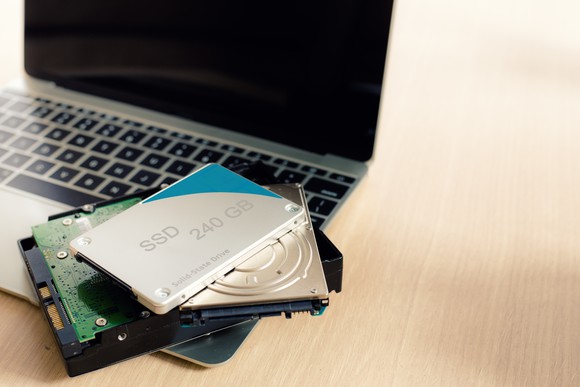
A laptop computer with storage drives lying on top of the keyboard.

Image source: Getty Images.

The state of the storage market

In recent years, lower shipments of PCs have translated to lower shipments of HDDs. The big growth opportunity for data storage companies is in solid state drives (SSDs), which are much faster and consume less power than HDDs. Global shipments of HDDs reached their peak in 2010 at 651 million and� declined to 404 million in 2017, according to information gathered by Statista.�Meanwhile, global shipments of SSDs are growing rapidly and are expected to overtake HDD shipments by 2021, as you can see in this table.

Metric *2021 *2020 *2019 *2018 2017 2016 2015
HDD shipments 330 350 360 370 404 424.07 468.73
SSD shipments 360 320 280 235 190 140 105

Amounts in millions. Data gathered by Statista. �*Estimates.

Still, while shipments of HDDs are declining, Seagate and Western are seeing the total capacity shipped increase as data centers are attracted to the higher capacities and cost effectiveness of going with HDDs. Basically, data storage companies are seeing a decline in consumer demand but growing demand from enterprise for HDDs. As a result, IDC estimates that the HDD market will remain flat at $24 billion over the next few years.

But eventually, the advantages that SSDs offer, such as lower power consumption and faster data retrieval, will help them win out over the clunky, slower HDDs.�The SSD market is expected to grow about 15% per year through 2025, according to Grand View Research.

Western Digital is much better positioned in the SSD market than main rival Seagate. In 2016, Western acquired SanDisk, the maker of NAND flash memory (the storage technology used in SSDs) that's No. 3 in market share at 15%. Western derived 52% of its revenue from HDDs in the third quarter, whereas Seagate generates over 90% of its annual revenue from HDDs.�This leaves less than 10% of Seagate's revenue coming from SSDs, which exposes Seagate more than its rival to a declining HDD market.

Seagate management has been content to focus primarily on serving enterprise customers in the HDD market. This is fine for now, since there is healthy HDD demand from data centers. But data centers are also gradually ramping up their buying of SSDs, since they are more efficient.�As SSD technology develops and prices come down, there is a lot of uncertainty longer term as to whether Seagate will be adequately positioned if SSD adoption accelerates.

Pricing uncertainty presents challenges

Western Digital is clearly better positioned for SSD adoption than Seagate, but it won't be clear sailing for Western. SSD growth is a double-edged sword, since advances in flash storage technology will undoubtedly cause selling prices to rapidly decline. Lower selling prices present the biggest risk for these storage drive makers. Some of this pricing pressure stems from deep-pocketed rivals -- like�Intel�and Samsung, just to name two -- vying for position in the storage market.

To give an idea of what investors can expect, let's look at history to see how changes in pricing have impacted Seagate's revenue.

Between 2010 and 2013, Seagate's annual revenue whipsawed as the industry experienced volatile shifts in supply and demand for disk drives.�In 2010, Seagate's revenue spiked 16% from an industrywide supply shortage.�A year later, as companies caught up with demand, there was an oversupply, causing Seagate's revenue to decrease 4%.�Flooding that damaged factories in Thailand in 2012 caused a severe shortage and a spike in selling prices, which sent Seagate's revenue soaring 36%. Over the last five years, Seagate has seen its revenue gradually dwindle, as this table shows.

Metric TTM Through March 2018 2017 2016 2015 2014 2013
Revenue $10,775 $10,771 $11,160 $13,739 $13,724 $14,351
Earnings per share $4.55 $4.12 $2.26 $4.57 $5.04 $5.31
Gross margin 29% 29.5% 23.4% 27.8% 28% 27.5%

Amounts in millions except per-share data. Data source: Seagate SEC filings. Years are fiscal years ending in June. EPS data is non-GAAP. TTM = trailing 12 months.

Since 2013, Seagate has blamed price erosion from declining PC sales for its decline in revenue.�This has hit Seagate harder than Western Digital, since Western has been more active in making acquisitions to diversify. Here's how Western Digital has fared over the last five years:

Metric TTM Through March 2018 2017 2016 2015 2014 2013
Revenue $20,372 $19,093 $12,994 $14,572 $15,130 $15,351
Earnings per share $14.08 $9.19 $5.79 $7.76 $8.10 $8.51
Gross margin 36.9% 31.8% 26.4% 28.9% 28.9% 28.4%

Amounts in millions except per-share data. Data source: Western Digital SEC filings. Years are fiscal years ending in June. EPS data is non-GAAP. TTM = trailing 12 months.

As the table shows, Western Digital has actually managed to increase gross margin even while dealing with the�same headwinds�on pricing as Seagate. One way Western has been able to control costs is by acquiring component suppliers, giving it more control over more points of the supply chain. There could be more consolidation in the industry as companies seek to offset declining prices by looking for synergies with other companies to reduce costs.

Storage stocks are risky

The growth of data presents a big opportunity for Seagate and Western Digital, but Seagate is simply too dependent on the declining HDD market for me to have confidence it can capitalize on SSD adoption. Western's improving profitability from an effective cost-reducing strategy and�diversification�makes it the far less risky stock.

But I would still tread carefully in the storage industry. There are too many unknowns with respect to competition and its potential impact on pricing trends, making it difficult to predict what these companies' earnings streams will look like over the long term.